Theme
Interview 1
Interview 1
법조계 실무까지 확산하는 AI
여전히 중요한 것은 인간의 혜안
AI Spreading into Legal Practice
Still, Human Insight Remains as Vital as Ever
한양대 법학전문대학원 선지원 교수
Professor Sun Ji-won, Hanyang University School of Law
- 글 김현지
- 사진 이현구
- Writing by Kim Hyun-ji
- Photograph by Lee Hyun-gu
Scroll Down
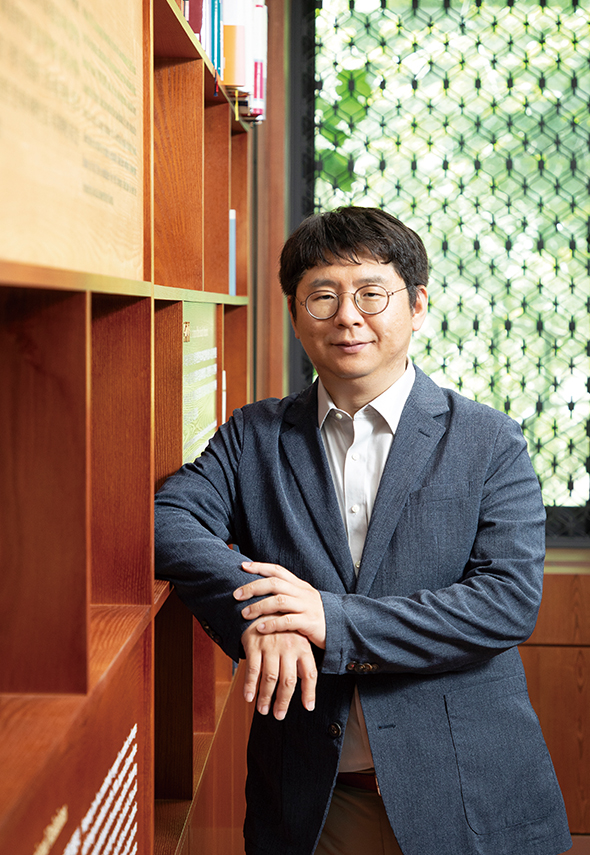
법률가, 특히 공법을 연구하는 법률가는 사회 변화에 기민하게 반응해야 한다. 새로운 현상이 나타났을 때 그것이 우리 사회에 어떤 영향을 미치는지 파악하고, 그에 따른 법제도 대응과 법의 역할을 고민해야 하기 때문이다. 한양대 법학전문대학원 선지원 교수는 그동안 AI를 비롯한 신기술이 사회공동체와 개인의 삶에 미치는 영향, 규제 변화에 관심을 기울여 왔다.
Jurists —especially those who study public law—must respond nimbly to social change. When a new phenomenon emerges, they must grasp the impact it has on our society and consider how the legal system should respond and what role the law should play. Professor Sun Ji-won of Hanyang University School of Law has long paid attention to how new technologies such as AI affect the community and individuals' lives, and to the regulatory changes they bring.
AI 기술 발전과 필연적으로 연결되는 법학
“공법, 규제 분야를 연구하며 우리 사회의 디지털 전환과 데이터, AI 관련 법학 연구를 진행해 왔습니다. 박사학위 취득 후 정보통신정책연구원에서 근무하게 된 것이 직접적인 계기가 됐죠. 하지만 공법학 연구자로서 AI 기술 발전에 관심을 가지게 된 것은 필연적인 일이라고 생각합니다. 최근 공법학 관련 학술지에도 AI 관련 연구 내용이 굉장히 많이 실리고 있어요.”
선지원 교수가 진행해 온 AI 관련 연구는 크게 두 갈래로 나눌 수 있다. 첫째는, 새로운 기술 탄생에 발맞춘 법제도 마련이다. AI와 같은 첨단기술이 발전하고 그 사용이 보편화됨에 따라 기본권 보호를 비롯한 기존의 법적 가치를 어떻게 반영할 것인가에 대한 문제가 중요해졌다. 둘째는, 기존의 법질서에서 AI를 어떻게 활용할지에 관한 것이다. 즉, 국가 행정에 데이터나 AI를 활용하는 방안과 그에 따른 리스크 제어가 핵심이다.
“구글이 개발한 ‘알파고’가 큰 파장을 일으킨 2016년을 기점으로 AI 분야에 대거 투자가 단행됐습니다. AI 기술이 혁신적으로 발전하는 분위기 속에서, 2018년부터 유럽연합(EU)과 OECD, 유네스코 등의 국제기구와 주요 국가들이 AI 윤리에 관한 논의를 본격화했습니다. OECD나 유네스코의 AI 윤리 논의 과정에는 우리나라도 적극적으로 참여해 왔고요. 재미있는 점은 각 기구의 성격에 따라 AI 윤리에 접근하는 방식과 내용 또한 차이가 있다는 점입니다. EU는 회원국 간의 연대, OECD는 해당 산업 발전 시에 생길 수 있는 리스크 제어, 유네스코는 에너지와 환경 문제 등 문화·생태적 가치에 초점을 맞췄죠.”
선지원 교수는 법제도 측면에서도 데이터 공유 활성화, 전자정부의 AI 활용 기반 조성 등을 뒷받침하기 위한 규범들이 등장하고 있다고 설명했다. 그러나 AI에 대해 직접적으로 규율하는 규범은 없었다.
Law, Inevitably Linked to the Advance of AI Technology
“While studying public law and regulation, I have carried out legal research on our society's digital transformation, data, and AI. Working at the Korea Information Society Development Institute (KISDI) after earning my doctorate was the direct catalyst. But I think it was inevitable for a public-law researcher to take an interest in the advance of AI technology. Recently, a great deal of AI-related research has been appearing in public-law journals as well.”
Professor Sun's AI-related research can be divided broadly into two parts. The first is creating legal institutions that keep pace with the birth of new technologies. As cutting-edge technologies like AI advance and their use becomes widespread, the question of how to reflect existing legal values—including the protection of fundamental human rights—has grown more important. The second concerns how to use AI within the existing legal order. In other words, the focus is on how to apply data and AI in public administration and how to control the attendant risks.
“Starting in 2016, when Google's “AlphaGo” caused a major stir, massive investment poured into the AI field. Amid this atmosphere of revolutionary progress in AI technology, since 2018, international organizations such as the European Union (EU), the OECD, and UNESCO, along with major countries, began discussions on AI ethics in earnest. Korea, too, has actively taken part in the AI ethics discussions at the OECD and UNESCO. What is interesting is that the approach to and substance of AI ethics differ according to each organization's character. The EU focused on solidarity among member states, the OECD on controlling the risks that may arise as the industry develops, and UNESCO on cultural and ecological values such as energy and environmental issues.”
Professor Sun explained that, on the legal-institutional side as well, norms have been emerging to support such efforts as promoting data sharing and establishing a foundation for the use of AI in e-government. Yet there had been no norm that directly regulated AI itself.
※ 자료 출처: 국가법령정보센터
※ Source: Korea Law Information Center
세계적 쟁점인 AI 법제도, 최초의 사례 된 대한민국
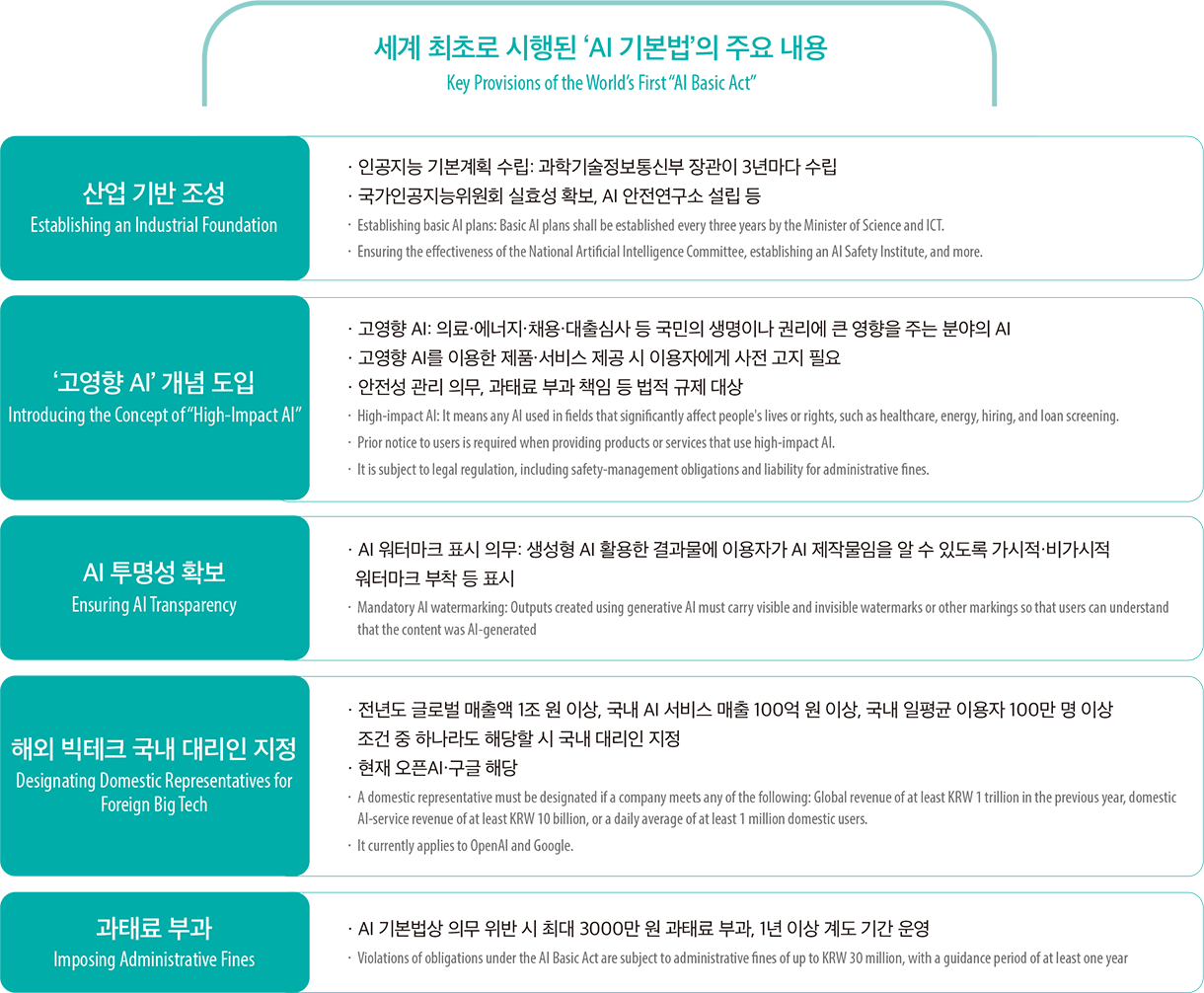
우리나라는 올해 1월 22일 「인공지능 발전과 신뢰 기반 조성 등에 관한 기본법」(이하 ‘AI 기본법’)을 세계 최초로 시행했다. 전 세계에서 AI 규제법을 전면 시행하는 첫 번째 국가가 된 것이다. EU가 우리보다 앞서 ‘AI Act’를 입법했지만 일부 회원국이 반발하며 올해 8월로 시행이 늦춰졌고, 이에 따라 대한민국이 ‘세계 최초’의 타이틀을 거머쥐게 됐다. AI 기본법의 핵심 내용은 AI 기반 산업의 발전을 위한 진흥이지만, ‘고영향 AI’에 대한 통제 등 윤리와 신뢰성 확보에 대한 내용도 포함돼 있다.
“AI 기본법은 단일 규제법이 아닙니다. 국가 차원의 AI 정책 방향과 원칙을 정리한 프레임워크 법에 가깝죠. 국가의 성장동력으로서 AI라는 기반 기술을 적극 활용할 수 있도록 물적, 인적, 제도적 기반을 제공하는 것이 핵심 내용입니다. 다만, AI를 산업 발전 동력으로 활용하기 위해서는 그 리스크에 대한 제어도 필요하기에 ‘고영향 AI’에 대한 안전성 확보 의무 등이 포함됐습니다.”
AI 기본법에는 아쉬운 점도 있다. 아무래도 급하게 입법을 추진하다 보니, 개념 등에 대한 정밀한 설계가 부족했다는 지적이다. 예를 들어, 리스크 규제의 대상이 되는 고영향 AI의 개념을 단순히 특정 분야에서 사용되는 AI로 설정했는데, 같은 분야에서 사용하더라도 사용 방식과 주체에 따라 리스크가 달라질 수 있다는 점이 고려되지 않았다. 실제 산업과 생활에 쓰이는 것은 AI 자체보다는 AI를 활용한 애플리케이션이다. 선지원 교수는 향후 각 활용 영역에서 AI 기본법의 내용을 바탕으로 법제도를 더 발전시켜 나갈 것으로 보인다고 설명했다.
AI Legislation, a Global Issue—and Korea Becomes the First Case
On January 22 this year, Korea became the first country in the world to enforce the Framework Act on the Development of Artificial Intelligence and the Creation of a Foundation for Trust (hereinafter the “AI Basic Act”). It thus became the world’s first nation to fully implement an AI regulatory law. Although the EU legislated its “AI Act” ahead of Korea, opposition from some member states pushed its enforcement back to this August, and as a result Korea claimed the title of “world first.” The core of the AI Basic Act is the promotion of AI-based industry, but it also includes provisions on securing ethics and trustworthiness, such as controls on “high-impact AI.”
“The AI Basic Act is not a single regulatory statute. It is closer to a framework law that lays out the direction and principles of national AI policy. Its core is to provide the material, human, and institutional foundations for actively using AI as a base technology that drives national growth. That said, because harnessing AI as an engine of industrial development also requires controlling its risks, the Act includes obligations to ensure the safety of “high-impact AI,” among other measures.”
The AI Basic Act is not without its shortcomings. Because the legislation was pushed through in haste, critics note that key concepts were not designed with sufficient precision. For example, the Act defines high-impact AI—the target of risk regulation—simply as AI used in certain fields, without taking into account that risk can vary with how and by whom the AI is used, even within the same field. What is actually used in industry and daily life is not AI itself so much as the applications built on it. Professor Sun explained that, going forward, the legal framework is likely to develop further in each area of application on the bases of the AI Basic Act.
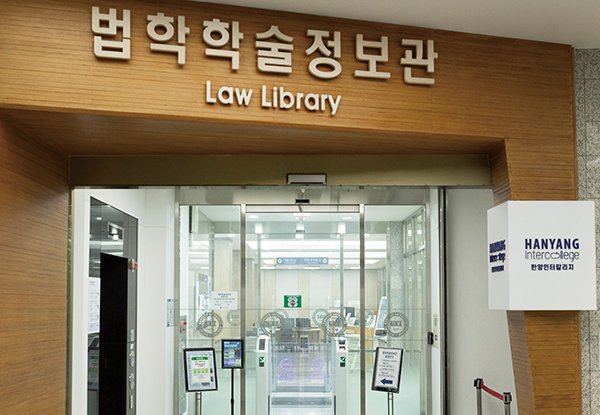
법률가가 제대로 일하기 위해서는 반드시 관련 자료를 발굴해야 한다. 한양대 법학전문대학원은 지하 4층, 지상 4층 규모의 법학학술정보관을 구축하고 예비 법조인을 지원하고 있다.
To do their work properly, legal professionals must unearth the relevant materials. Hanyang University School of Law has built a Law Library—four stories above ground and four below—to support aspiring legal professionals.
AI가 거의 모든 영역과 분야로 확산하며 ‘AI 기본법’과 같은 새로운 법제도 마련과 기존 법질서에서 AI 기술을 어떻게 활용할지가 중요한 쟁점이 됐다
As AI spreads into virtually every domain and field, establishing new legal frameworks such as the “AI Basic Act”—and determining how to use AI technology within the existing legal order—has become a critical issue.

선지원 교수는 AI 시스템이 결과를 빠르게 도출해 내더라도 결국 그 과정을 설명하는 일은 법률가의 역할이라고 강조했다.
Professor Sun emphasized that even when an AI system produces results quickly, explaining the process is ultimately the legal professional's role.
법학은 과정의 학문, AI는 유용한 도구
AI가 거의 모든 업종, 분야로 확산하며 영향력을 발휘하는 가운데 법조계에서도 AI 활용이 가속화하고 있다. 법률가가 제대로 일하기 위해서는 반드시 관련 자료를 발굴해야 한다. 디지털 전환을 겪으며 기존에도 법제처나 대법원에서 제공하는 플랫폼들이 활용돼 왔지만, 정확한 키워드를 알지 못하면 판례나 법령을 찾기 어려웠다. 그 한계가 분명했다. 그러나 최근 서비스되는 LLM(대규모 언어 모델) 기반의 법률 정보 플랫폼은 문제의식만 가지고도 관련 자료들을 쉽게 찾아낼 수 있다.
“판례나 법령 서치, 분석뿐 아니라 이제 소장 등의 서면을 대신 작성해 주는 AI 시스템까지 등장해 법률가의 업무 부담을 상당 부분 덜어주고 있습니다. 그러나 법률가의 사고 흐름까지 완벽하게 대체하지는 못합니다. 세상에 완전히 동일한 사례는 없죠. 법률 판단에서는 아주 사소한 사실관계라도 중요할 수 있는데, 현재의 AI 시스템은 이런 부분들을 간과하는 것으로 보입니다.”
아직은 AI가 법률가의 역할을 따라잡을 수 없다는 게 선지원 교수의 판단이다. 하지만 미래에도 그럴지는 미지수다. 불과 5~6년 전만 해도 예상할 수 없었던 AI 기술들이 우리 앞에 등장하고 있다. 리걸테크(Legal-Tech) 역시 앞으로 어떻게, 어디까지 발전할 수 있을지 장담하기 어렵다.
이렇게 변화하는 시대에 맞춰 법학 교육 역시 달라져야 할 터. 한양대 법학전문대학원을 시작으로 국내 대학에서도 리걸테크 수업이 추진되고 있다. 국내 AI 시대를 살아갈 법학 인재들에게는 어떤 마인드가 필요할까.
“법학은 과정의 학문입니다. 따라서 답 자체가 중요하다기보다는 사실과 규범을 발견하고, 사실을 규범에 적용해 나가는 과정을 논증하는 것이 핵심입니다. AI 시스템은 결과를 빠르게 도출해 내지만, 결국 그 과정을 설명하는 일은 법률가의 역할입니다. 예비 법률가들은 이 점을 유념하고, 자료 검색과 발견에는 AI를 적극 활용하되 AI가 내어주는 결과에 의존하지 않아야 합니다.”
선지원 교수는 앞으로도 AI를 비롯한 신기술이 초래하는 사회 변화와 그에 대한 법제도 대응 문제를 지속적으로 연구할 계획이다. 그동안 인류가 쌓아온 지혜가 축적된 전통적인 법학 이론들을 신기술 영역에서 어떻게 새로이 활용할 수 있을지도 고민 중이다.
“제자들이 우리 사회 곳곳에 진출하고, 사제지간을 넘는 연구 동반자로서 함께 공동체에 도움이 되는 정책 연구를 많이 해나가면 좋겠습니다. 이른바 ‘AI 시대’가 되어도, 주인공은 여전히 AI를 이용하는 사람들이라고 믿습니다. 이 주체성을 잃지 않고 적극적으로 기술 활용을 주도해 나가되, 그 기술이 미치는 파급력과 함의를 이해할 수 있는 한양인들이 되길 바랍니다.”
Law Is a Discipline of Process; AI Is a Useful Tool
As AI spreads across nearly every industry and field and exerts its influence, its use is accelerating in the legal field as well. To do their work properly, legal professionals must unearth the relevant materials. Through the digital transformation, platforms provided by the Ministry of Government Legislation and the Supreme Court had already been in use, but without knowing the exact keywords it was hard to find precedents or statutes. The limits were clear. Recently, however, legal-information platforms based on LLMs (large language models) can easily locate relevant materials with nothing more than a sense of the issue at hand.
“AI systems now not only search and analyze precedents and statutes but even draft documents such as complaints, relieving legal professionals of a substantial part of their workload. Still, they cannot perfectly replace a legal professional's flow of reasoning. No two cases in the world are exactly alike. In legal judgment, even the smallest point of fact can matter, yet current AI systems appear to overlook such details.”
For now, Professor Sun judges that AI cannot catch up with the legal professional's role. Whether that will hold true in the future, however, is uncertain. AI technologies that could not have been imagined just five or six years ago are appearing before us. It is likewise hard to guarantee how—and how far—legal technology (legal-tech) can advance.
Legal education, too, must change to keep pace with these shifting times. Beginning with Hanyang University School of Law, universities in Korea are introducing legal-tech courses. What mindset will the legal talents who will live through Korea's AI era need?
“Law is a discipline of process. The answer itself matters less than the process of discovering facts and norms and reasoning through how the facts apply to the norms. AI systems produce results quickly, but in the end it is the legal professional's role to explain that process. Aspiring legal professionals should keep this in mind: make active use of AI to search for and discover materials, but do not depend on the results that AI hands them.”
Professor Sun plans to continue researching the social changes brought about by AI and other new technologies and how the legal system should respond. He is also reflecting on how the traditional theories of law—repositories of the wisdom humanity has accumulated—can be put to fresh use in the realm of new technology.
“I hope my students will go out into every part of our society and that, as research partners beyond the teacher–student relationship, we will carry out a great deal of policy research that benefits the community together. Even in the so-called “AI era,” I believe the protagonists are still the people who use AI. I wish for Hanyangians who do not lose this sense of agency to actively lead the way in using technology while understanding the consequences and implications it carries.”
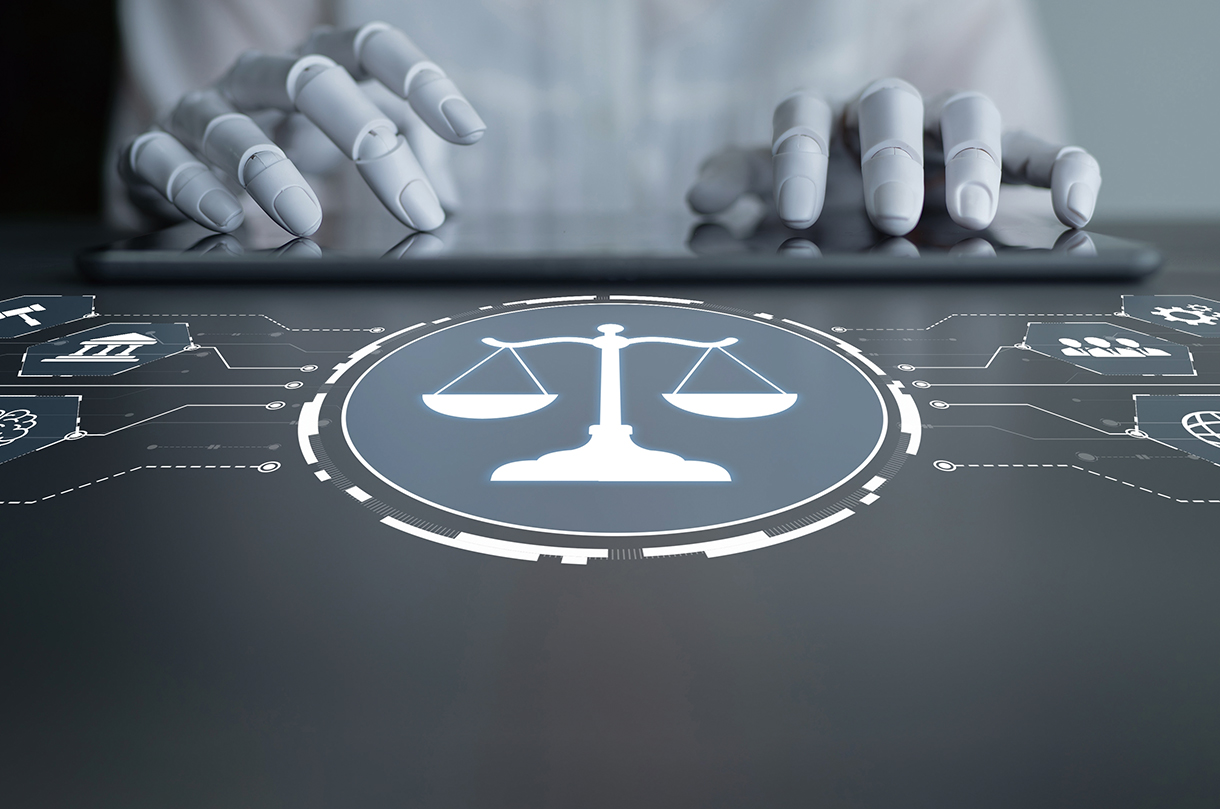
AI가 거의 모든 업종, 분야로 확산하며 영향력을 발휘하는 가운데 법조계에서도 AI 활용이 가속화하고 있다.
As AI spreads across nearly every industry and field and exerts its influence, its use is accelerating in the legal sector as well.