
Theme
Interview 2
Interview 2
인체와 기계의 양방향 소통을 위한
BCI 반도체 칩 기반 기술 연구
Research on BCI Semiconductor Chip-Based Technology
for Two-Way Communication Between the Human Body and Machines
전기·생체공학부 바이오메디컬공학전공 이병훈 교수
Professor Byunghun Lee, Major in Biomedical Engineering,
School of Electrical and Biomedical Engineering
- 글 박영임
- 사진 손초원
- Writing by Park Young-im
- Photograph by Son Cho-won
Scroll Down
의료·바이오 시스템 반도체의 기반을 다지고 있는 이병훈 교수는 한국연구재단의 ‘뇌과학 선도융합기술 개발사업 과제’를 수주하는 등 특히 뇌공학 분야의 연구를 활발히 진행하고 있다. 이병훈 교수를 만나 의학과 공학의 융합으로 현대 의료의 혁신 속도를 높이고 있는 바이오메디컬공학 연구에 대해 들었다.
Professor Byunghun Lee, who is laying the groundwork for medical and bio-system semiconductors, has been actively conducting research in the field of brain engineering, including securing funding for the “Brain Science Leading Convergence Technology Development Project” from the National Research Foundation of Korea (NRF). We spoke with Professor Lee about his biomedical engineering research, which is accelerating innovation in modern healthcare through the convergence of medicine and engineering.

인간의 뇌와 외부 기기의 연결
명실상부 이 시대 혁신의 아이콘이 된 테슬라의 일론 머스크 CEO가 전기차, 로봇, 우주개발에 이어 주목하고 있는 다음 분야는 뇌와 컴퓨터를 연결해 생각을 읽어내는 BCI(Brain Computer Interface)다. 이미 2016년 뇌신경 과학 스타트업 ‘뉴럴링크(Neuralink)’를 설립해 기술 개발에 박차를 가하고 있다. 지난 1월에도 전신마비 환자가 뇌에 이식한 칩을 이용해 비디오 게임을 즐기는 모습을 공개해 화제를 모았다. 한양대 뇌공학연구센터의 일원으로 한국연구재단의 ‘뇌과학 선도융합기술 개발사업’을 수주한 이병훈 교수 또한 BCI 분야에서 활약하고 있다.
“뇌나 신경에서 나오는 신호를 전기적으로 변환해 기계와 자연스럽게 연결하는 연구를 하고 있습니다. 뇌나 신경의 신호를 읽고 분석해 의도한 대로 기기를 움직이게 하는 것이죠. 반대로 뇌에 자극을 제공할 수도 있습니다. 이는 알츠하이머, 파킨슨, 간질 같은 뇌 질환 치료나 재활에 도움을 줄 수 있습니다.”
이병훈 교수는 인간 뇌와 외부 기기의 연결에서 중요한 키워드는 양방향 소통이라고 강조했다. 그래서 생체신호를 측정하고 자극하는 회로·시스템뿐 아니라 그러한 시스템이 체내에서 잘 구동되도록 돕는 무선 전력 및 데이터 전송 기술도 함께 연구하고 있다. 삼성서울병원 신경과 교수 연구팀과 공동연구로 진행 중인 뇌과학 선도융합기술 개발사업 과제에서도 뇌와 외부 기기를 잇는 양방향 통신과 무선 전력 공급, 그리고 이를 구현할 BCI 반도체 칩 기반 기술을 단계적으로 구축하고 있다.
“관건은 아주 미세한 뇌 신호를 노이즈 속에서도 정확히 읽고, 필요한 만큼만 정밀하고 안전하게 자극하면서 이 모든 것을 무선으로 구동하는 ㎜급 초소형 임플란트(체내 삽입형 기기) 플랫폼을 구현하는 것입니다. 뇌공학이 단지 상상 속에만 존재하는 기술이 아니라, 의료 현장에서 실현될 수 있도록 뼈대를 세우는 과정이라고 보시면 됩니다.”
Connecting the Human Brain to External Devices
Elon Musk, CEO of Tesla—widely regarded as one of the defining icons of innovation of our time—has turned his attention, following electric vehicles, robotics, and space development, to BrainComputer Interface (BCI) technology, which connects the brain to computers to read thoughts. Having founded the neurotechnology startup “Neuralink” in 2016, he has been pushing the boundaries of the technology ever since. Most recently, in January, footage of a fully paralyzed patient playing a video game using a chip implanted in his brain drew widespread public attention. Professor Byunghun Lee, a member of Hanyang University's Research Center for Brain and Cognitive Engineering who has secured the NRF's “Brain Science Leading Convergence Technology Development Project,” is also making his mark in the BCI field.
“My research focuses on converting electrical signals from the brain and nervous system to seamlessly interface with machines— reading and analyzing those signals to control devices according to the user's intent. The connection also works in reverse: stimulation can be delivered back to the brain. This holds promise for the treatment and rehabilitation of brain disorders such as Alzheimer's disease, Parkinson's disease, and epilepsy.”
Professor Lee emphasized that the key to connecting the human brain to external devices is two-way communication. He is therefore researching not only the circuits and systems that measure and stimulate biosignals, but also the wireless power and data transmission technologies that enable such systems to function reliably inside the body. In a Brain Science Leading Convergence Technology Development Project conducted jointly with a neurology research team at Samsung Medical Center, he is also systematically building two-way brain-to-device communication, wireless power delivery, and the BCI semiconductor chip-based technologies needed to bring these capabilities to life.
“The key challenge is building a millimeter-scale ultra-compact implant platform that can accurately read the brain's extremely faint signals even in the presence of noise, deliver precisely calibrated and safe stimulation, and run entirely on wireless power. Think of it as laying the groundwork so that brain engineering moves beyond the realm of imagination and becomes something that can actually be realized in clinical settings.”
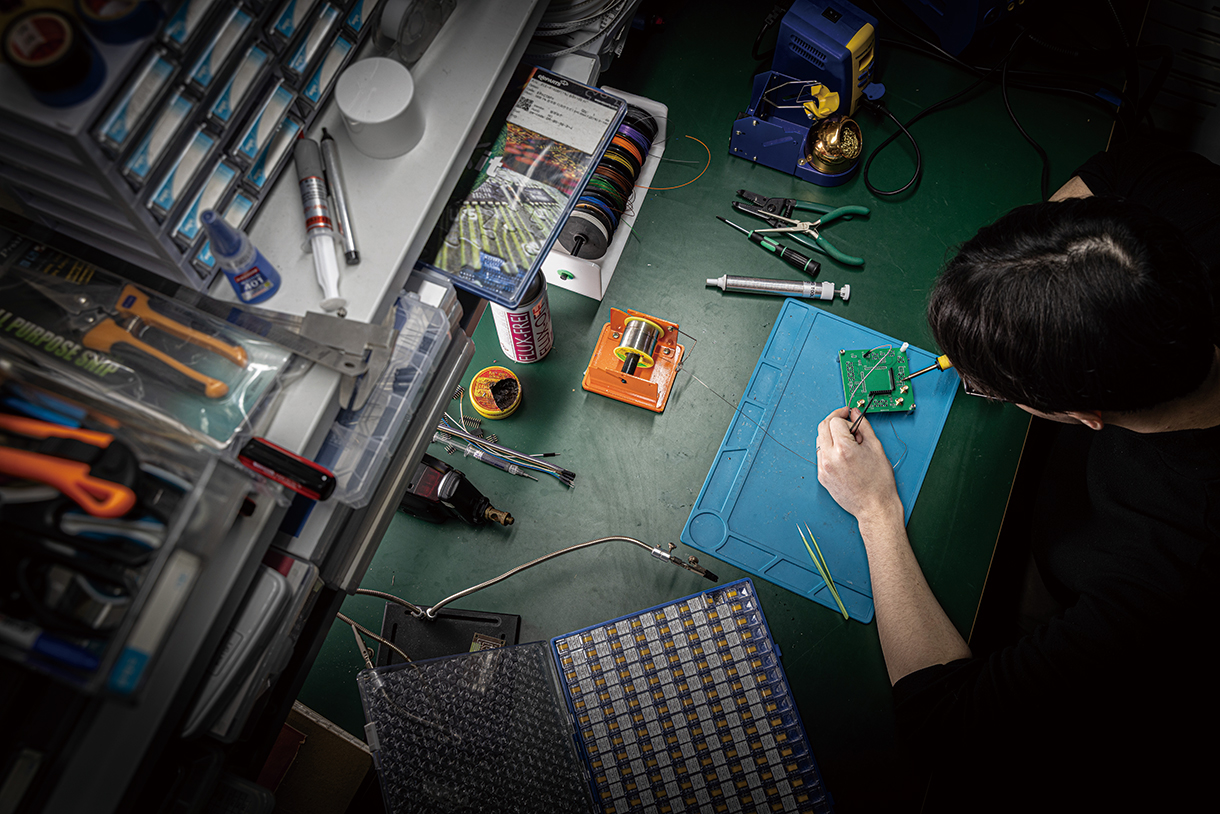
첨단 의료가 발전하려면 생체신호를 측정하고 자극하는 회로·시스템과 이를 지원하는 무선 전력‧데이터 전송 기술 등 공학 분야가 뒷받침돼야 한다.
For advanced medicine to progress, it must be supported by engineering disciplines— including circuits and systems that measure and stimulate biosignals, as well as wireless power and data transmission technologies.
무선 전력 및 통신이 의료기기의 핵심
하지만 체내의 전파(RF) 환경은 매우 복잡하다. 인체 안에 삽입해야 하므로 안테나를 크게 만들 수 없거니와 지방이나 수분, 뼈 등이 전파를 방해한다. 또한 전력의 고질적 문제인 발열은 체내에서는 더욱 치명적인 문제가 된다. 심부체온이 상승하면 생명에 위협을 줄 수 있기 때문이다.
“의료기기라 하면 보통 AI를 떠올리기 쉬운데 사실 AI가 잘 구동되려면 먼저 전력, 그리고 몸속에서 안전하게 동작할 반도체 회로가 깔려야 합니다. 궁극적으로 배터리 없이도 쓸 수 있도록 무선으로 전력과 데이터를 전달하는 기술이 필요합니다. 이런 기술이 의공학과 만나면 환자 입장에서는 배터리·관리 부담이 줄고, 의료진 입장에서는 보다 안정적으로 장치를 운용할 수 있습니다.”
이와 같은 헬스케어 및 의공학 발전에 힘입어 앞으로는 눈에 보이지 않는 작은 기기들이 심장, 호흡, 혈관, 뇌 같은 생체신호를 24시간 모니터링해 위험 신호를 조기에 감지해 주는 시대가 될 것이다. 더 나아가 치료까지 해주는 웨어러블 기기나 삽입형 기기가 확산할 것으로 전망된다. 이러한 기기들이 24시간 원활히 구동되려면 배터리 교체나 충전 같은 불편을 없애야 한다.
이병훈 교수는 열악한 전파 환경 속에서도 여러 기기에 전력과 데이터를 동시에 안정적으로 전달하는 기술을 개발해 2025년 12월 국제전기전자기술협회 산업정보학학회 저널(IEEE Transactions on Industrial Informatics) 온라인판에 발표했다. 최근에는 더 많은 채널에서 뇌 신호를 안정적으로 기록하고 필요한 자극을 제공하는 대용량 BCI 반도체 회로를 연구하고 있다. 향후 영장류 실험과 임상 적용까지 단계적으로 진척시킬 예정이다. 또한 노화로 인해 저하된 근력을 보강해 주는 디바이스용 저전력 반도체 회로도 연구 중이다. 체내에서 장시간 동작할 수 있도록 전력, 발열, 안전성 부문을 충족하면서 동시에 충분한 구동 성능을 발휘하는 회로와 시스템 개발이 과제다.
“바이오메디컬 분야에서 무선 전력, 무선 통신 같은 보이지 않는 인프라 기술이 핵심이 될 것이라 생각합니다. 현재 저는 생체신호 측정·자극 회로, 초소형 임플란트, 무선 전력·데이터 전송을 하나로 묶어서 의료 현장에서 믿고 쓸 수 있는 시스템으로 고도화하는 데 집중하고 있어요. 단순히 데모가 아니라 실제 임상 환경에서 안정적으로 구동할 수 있는 수준까지 끌어올리는 게 목표입니다.”
Wireless Power and Communication as the Core of Medical Devices
The radio frequency (RF) environment inside the human body, however, is extremely challenging. Since devices must be implanted inside the body, antennas cannot be made large, and fatty tissue, bodily fluids, and bone all interfere with radio waves.
Heat generation—a persistent issue with any power system— becomes even more critical inside the body, where a rise in core body temperature can pose a life-threatening risk.
“When people think of medical devices, AI tends to come to mind first. But for AI to function well, a reliable power supply must first be in place, along with semiconductor circuits that can operate safely inside the body. Ultimately, we need technology that can deliver both power and data wirelessly, enabling batteryless operation. When that kind of technology meets biomedical engineering, patients benefit from a reduced burden of battery management and upkeep, while medical professionals can manage devices with greater reliability.”
Fueled by these advances in healthcare and biomedical engineering, the future will be an era in which tiny, invisible devices monitor biosignals from the heart, respiratory system, blood vessels, and brain around the clock, catching warning signs at an early stage. Looking further ahead, wearable and implantable devices capable of delivering treatment are also expected to become widespread. For such devices to run smoothly around the clock, the hassles of battery replacement and recharging must be eliminated.
Professor Lee developed a technology for reliably delivering power and data to multiple devices simultaneously even in poor RF environments, and published the work online in December 2025 in IEEE Transactions on Industrial Informatics. He is currently researching high-channel-count BCI circuits capable of stably recording brain signals across more channels and delivering the necessary stimulation. The work is set to advance step by step toward primate experiments and, eventually, clinical application. He is also developing low-power semiconductor circuits for devices that compensate for muscle strength lost to aging. A central challenge is designing circuits and systems that meet the demands of power efficiency, thermal management, and safety for sustained in-body operation—while still delivering sufficient performance.
“I believe that invisible infrastructure technologies—wireless power and wireless communication—will become the backbone of the biomedical field. Right now, I'm focused on integrating biosignal measurement and stimulation circuits, ultra-compact implants, and wireless power and data transmission into a single, unified system that clinicians can confidently rely on. My goal is not just to build a proof-of-concept demonstration, but to bring the technology to a level where it can operate reliably in real clinical environments.”
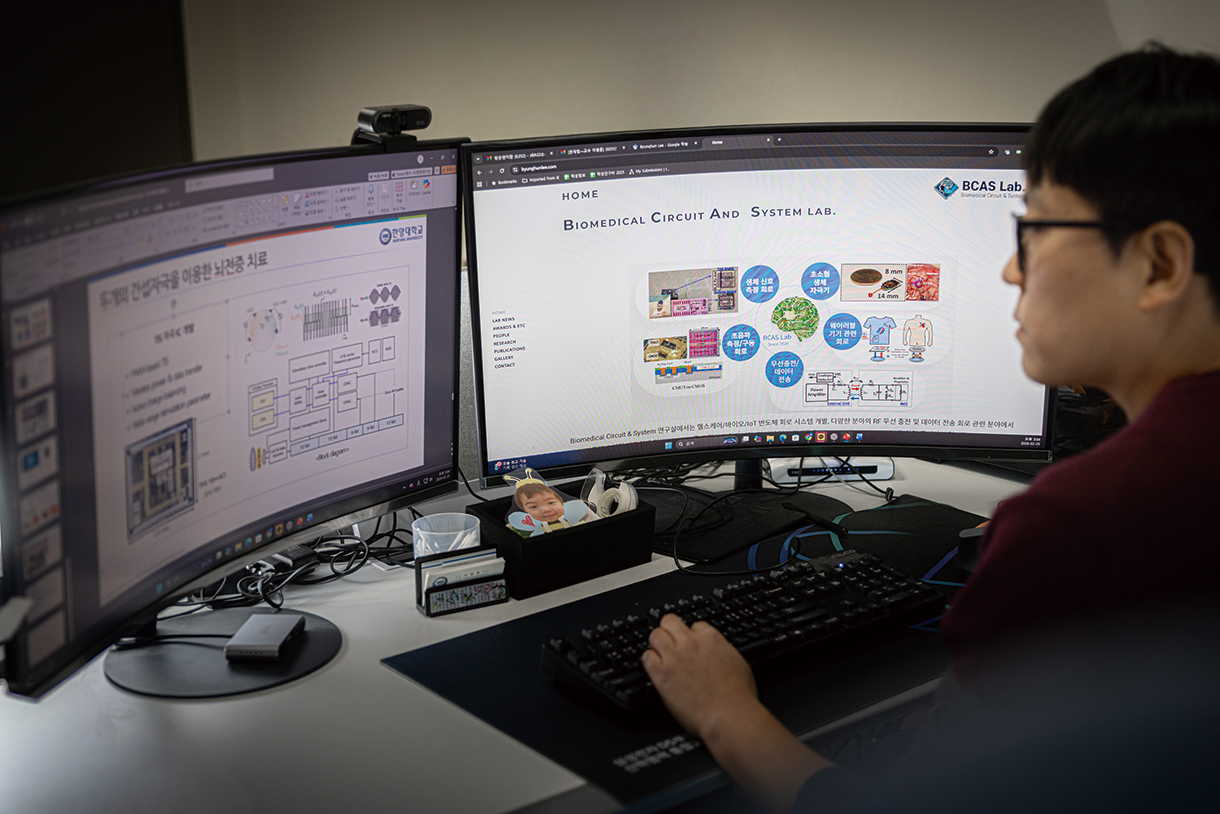
이병훈 교수는 뇌와 컴퓨터를 연결해 생각을 읽어내는 BCI 연구뿐 아니라 의료 현장에서 믿고 쓸 수 있는 시스템 고도화에도 집중하고 있다.
Professor Byunghun Lee focuses not only on braincomputer interface (BCI) research that connects the brain to computers to read thoughts, but also on advancing systems that can be reliably deployed in clinical settings.
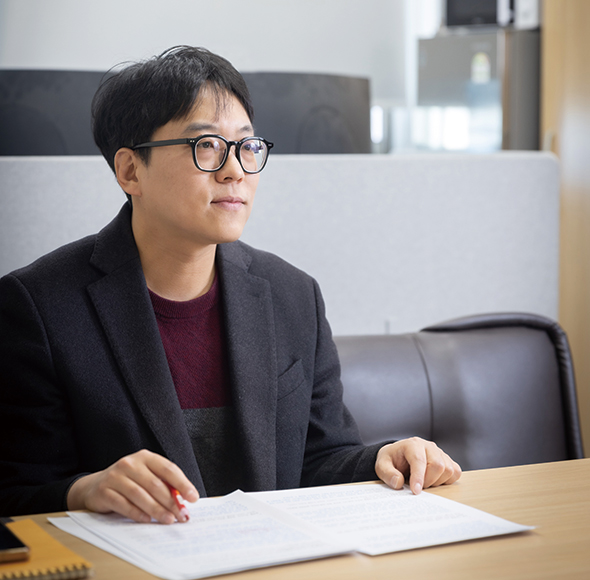
이병훈 교수가 몸담고 있는 전기·생체공학부 바이오메디컬공학전공은 의료 현장에서 질환을 치료할 수 있도록 돕는 도구와 시스템을 설계하고 구현한다.
The Major in Biomedical Engineering within the School of Electrical and Biomedical Engineering, where Professor Byunghun Lee works, designs and implements tools and systems that help treat diseases in clinical settings.
사람의 몸이라는 가장 복잡한 시스템을 다루는 바이오메디컬공학은 의료 현장과 시너지를 낼 수 있는 다양한 기기와 시스템을 설계하고 구현한다
Biomedical engineering, which addresses the most complex system—the human body— designs and implements diverse devices and systems that synergize with clinical practice.
임상 문제를 공학적으로 해결하는 바이오메디컬공학
이렇게 이병훈 교수가 몸담고 있는 전기·생체공학부 바이오메디컬공학전공은 의료 현장에서 질환을 치료할 수 있도록 돕는 도구와 시스템을 설계하고 구현하는 분야다. 그래서 주로 의과대학 교수들과 공동연구를 진행하는 경우가 많다. 이병훈 교수는 임상 환경에서 제기한 문제에 대해 회로, 통신, 전력 시스템 등 공학적 해법을 제시한다. 이를 통해 의학적 아이디어가 실제 작동하는 장치로 세상에 빛을 보게 되는 것이다.
“바이오메디컬 분야는 사람의 몸이라는 가장 복잡한 시스템을 다루기 때문에 한 분야의 전공만으로는 해결하기 어렵습니다. 실제 의료기기 하나를 완성하려면 소재, 반도체, 전력, 통신, AI, 임상 검증이 다 같이 맞물려야 합니다. 그래서 융합연구가 필수입니다.”
하지만 이병훈 교수가 말하는 융합은 단순히 서로 다른 것을 섞는 것을 의미하지 않는다. 각기 다른 분야가 사용하는 언어와 기준을 연결해, 하나의 통합된 시스템으로 작동하도록 만드는 일이 융합인 것이다. 이러한 융합은 타 분야의 언어로 번역해 소통하는 일로부터 시작된다. 예를 들어 ‘발열’이나 ‘오동작 허용치’ 같은 공학 언어는 ‘환자의 안전’이라는 임상 언어로 바꾸어 말해야 서로 소통할 수 있다.
“요즘 융합연구에서는 기술의 전이를 발견하는 사람이 속도를 냅니다. 혁신은 무에서 어느 날 갑자기 생겨나는 게 아닙니다. 다른 분야에서 당연하게 쓰이던 기술이 혁신의 열쇠가 되는 순간이 많죠. 그래서 한양인들에게 당장 내 전공과 상관없어 보이는 분야라도 관심을 가지라고 당부하고 싶습니다. 그리고 한 가지 더 강조할 점은 끈기를 갖고 끝까지 파고들어야 한다는 것입니다. 그 과정에서 진짜 실력이 만들어지는 것이니까요.”
Biomedical Engineering: Solving Clinical Problems Through Engineering
The Major in Biomedical Engineering within the School of Electrical and Biomedical Engineering, where Professor Lee is based, is a field dedicated to designing and implementing the tools and systems that help treat disease in clinical settings. Collaborative research with faculty from the College of Medicine is therefore very common. Professor Lee brings engineering solutions—circuits, communication, and power systems—to problems identified in clinical environments, allowing medical ideas to come to life as devices that actually work in the real world.
“Because the biomedical field deals with the most complex system there is—the human body—no single discipline can tackle it alone. To bring a single medical device to completion, materials science, semiconductors, power, communication, AI, and clinical validation must all converge seamlessly. That is why interdisciplinary research is not optional—it is essential.”
But the kind of convergence Professor Lee describes is not simply about mixing different things together. True convergence means connecting the languages and standards of different fields so that they function as one integrated system—and it begins with translating concepts across disciplinary boundaries. Engineering terms like “heat generation” or “error tolerance threshold,” for instance, must be reframed in the clinical language of “patient safety” before genuine communication between the two sides is possible.
“In convergence research today, those who can spot where a technology from one field can be applied to another have a real advantage. Innovation doesn't appear out of thin air. More often than not, a technology taken for granted in one discipline turns out to be the key that unlocks breakthroughs in another. That is why I would urge Hanyang people to stay curious about fields that may seem unrelated to their own major right now. And one more thing I want to stress: the importance of perseverance—of digging deep and seeing things through to the end. That is the process through which real capability is built.”
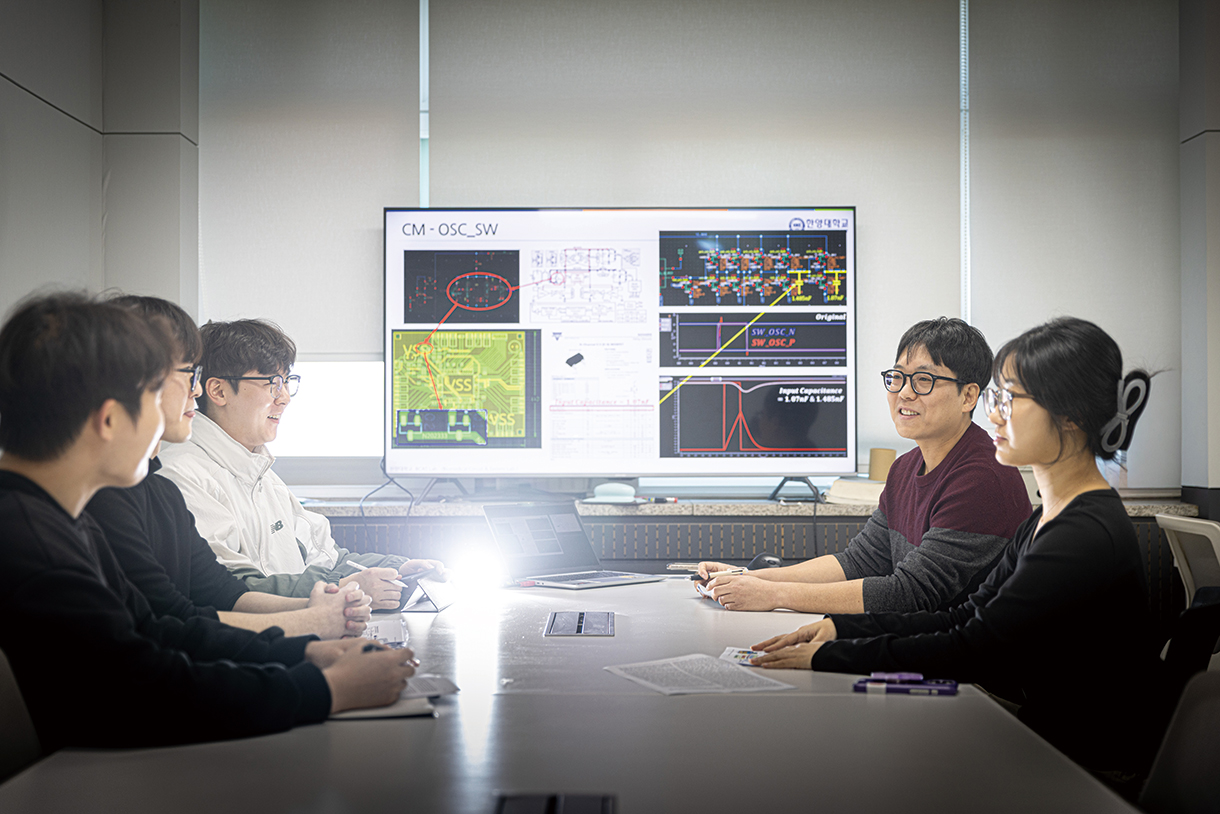
이병훈 교수는 학생들에게 공학과 의학 분야 간의 학문적 방법론, 기술 등을 상호 교환, 응용할 수 있는 의공학자의 중요성을 강조한다.
Professor Byunghun Lee emphasizes to his students the importance of biomedical engineers who can interchange and apply academic methodologies and technologies from both engineering and medicine.