Theme
Report
Report
우수한 의대와 공대 갖춘 한양
의료·바이오 생태계의 허브 될 것
Hanyang University, with Its Outstanding Medical and Engineering Schools,
to Become a Hub of the Medical and Bio Ecosystem
- 글 편집실
- Writing by Editorial Team
Scroll Down
미국은 이미 1960년대부터 국립보건원(NIH)과 같은 연방기관이 주도해 의사과학자 양성 프로그램을 운영해 왔다. 매년 의과대학 졸업생의 약 4%에 달하는 1,700명 정도가 의사과학자의 길을 선택하는 것으로 알려져 있다. 그에 비해 우리나라는 의사과학자가 턱 없이 부족하고, 의공학자 부문에서도 체계적이고 적극적인 지원이 더 필요한 실정이다. 미래 의료‧바이오 분야 인재 양성을 위해 꾸준히 준비해 온 한양대의 발걸음을 소개한다.
The United States has been running physician-scientist training programs led by federal agencies such as the National Institutes of Health (NIH) since as early as the 1960s. It is estimated that approximately 1,700 people—about 4% of annual medical school graduates—choose a career as physician-scientists each year. In contrast, Korea has a significant shortage of physician-scientists, and the field of biomedical engineering also requires more systematic and proactive support. Here, we introduce the steps that Hanyang University has steadily taken to cultivate talent for the future medical and bio sectors.
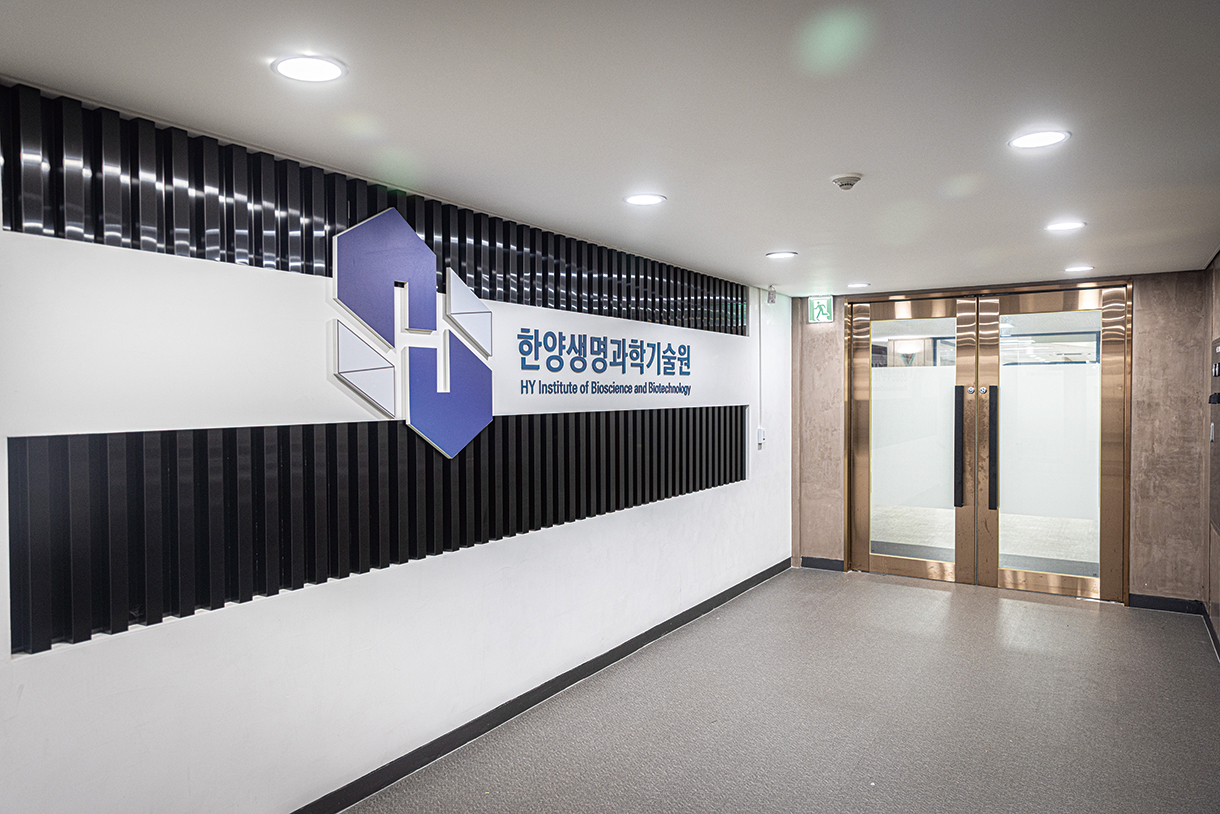
한양대는 한양생명과학기술원(HY-IBB)을 개원하고 의학과 공학, 자연과학 분야 연구자들이 함께하며 시너지를 낼수 있는 집단연구 시스템을 구축했다.
Hanyang University opened the Hanyang Institute of Bioscience and Biotechnology (HY-IBB) and established a collaborative research system that brings together researchers in medicine, engineering, and the natural sciences to promote interdisciplinary collaboration.
다양한 교육과정과 시스템으로 키우는 융합인재
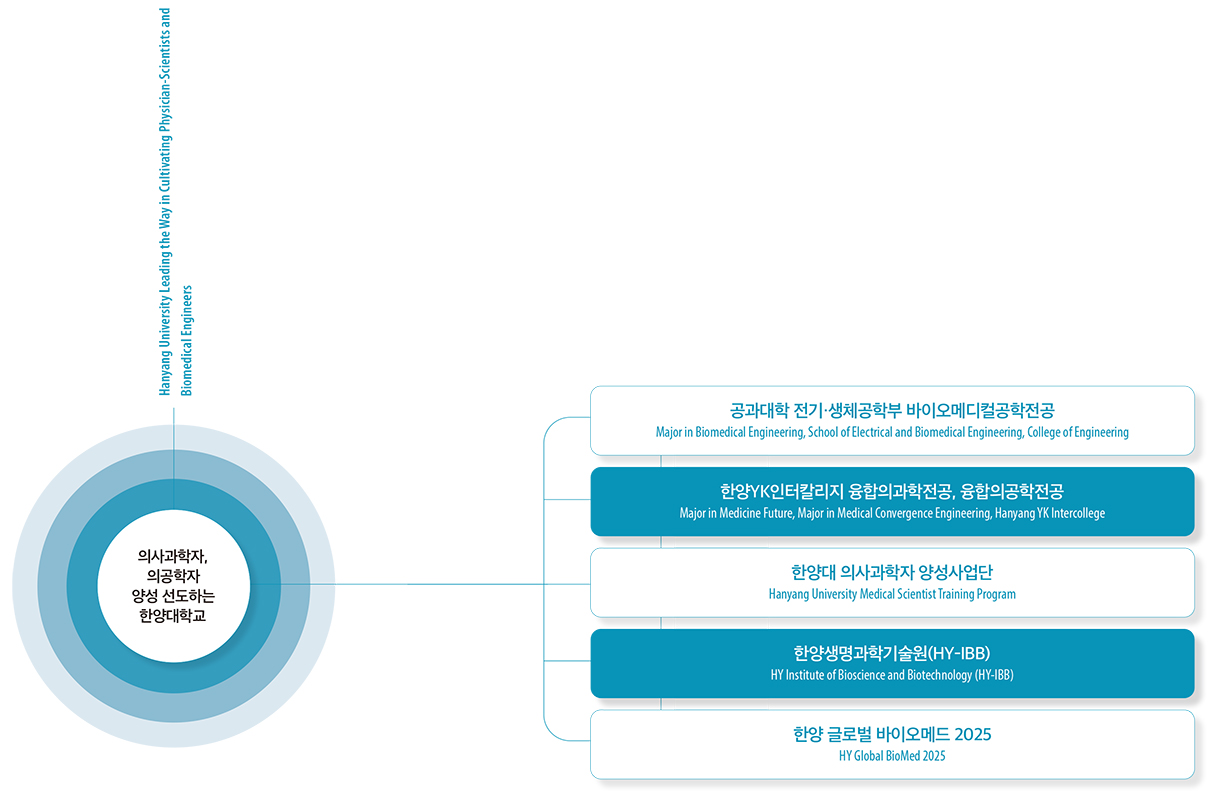
뛰어난 의사과학자와 의공학자를 배출하기 위해서는 그에 맞는 교육과정과 시스템, 지원책이 마련돼야 한다. 한양대는 공과대학 내에 전기‧생체공학부 바이오메디컬공학전공을 설치하고, 체계적인 교육으로 전통적인 생체공학과 미래 바이오 분야를 아우를 인재를 양성해 왔다. 여기에 더해 최근에는 새로운 교육 시스템을 도입했다. ‘유연하고 개방적인 사고로 시대의 문제를 해결하는 인재를 육성한다’는 콘셉트로 2025년 다전공 융합교육에 집중하는 한양YK인터칼리지를 신설한 것이다. 그리고 이 한양YK인터칼리지 학부 전공과정으로 ‘융합의과학’과 ‘융합의공학’을 개설했다. 새로운 교육 시스템을 통해 더 유연한 사고를 지닌 의사과학자와 의공학자를 배출한다는 계획이다.
한양대는 또 2025년 하반기 보건복지부의 ‘융합형 의사과학자 양성 사업’에 선정됨에 따라 의사과학자 양성에서도 에너지를 얻게 됐다. 미래인재양성단 산하에 ‘한양대 의사과학자 양성사업단’을 설립하고, 전 주기적 융합형 의사과학자 양성을 본격화했다. 보건복지부의 지원을 받아 한양대는 △융합형 의사과학자 양성 학부과정 △융합형 의사과학자 양성 대학원과정 △박사후 연구 성장 지원 과정을 운영할 예정이다.
*공과대학 전기‧생체공학부 바이오메디컬공학전공
한양대는 1996년 대학원 학과 간 협동과정으로 의용생체공학과를 처음 개설했다. 이어 2005년 공과대학 생체공학과, 2013년 일반대학원 생체공학과를 설치했다. 2022년에는 학과의 범위와 가능성을 더 확장한다는 취지에서 학과명을 바이오메디컬공학전공으로 변경했다.
바이오메디컬공학이 다루는 학문 분야는 거의 모든 임상 및 기초의학 분야와 연결되며, 공학과 자연과학 분야를 포함하는 아주 폭넓은 영역이다. 각종 진단 및 치료 기기의 개발뿐 아니라 인공 심장, 인공 귀 등의 인공 장기에 관한 연구, 막대한 양의 환자 및 유전자 정보를 처리하는 생명 의료 정보 분야, 21세기의 블루칩으로 불리는 뇌공학 분야 등을 아우른다.
*한양YK인터칼리지 융합의과학전공
한양YK인터칼리지 융합의과학전공은 의학, 데이터사이언스, 보건의료 정책 분야의 첨단 기술과 융합적 실천 능력을 바탕으로, 의과학 연구-의료 데이터-보건의료 정책-산업을 연결하는 인재를 양성하기 위해 신설됐다. 의과학, 보건학, 데이터사이언스 등 의학을 기반으로 하는 여러 학과가 함께 참여하는 집합 과정으로, 기존 의(과)학 교과과정을 보건정책·데이터·산업 영역으로 확장한다.
전통적인 생명과학이 세포·분자 수준의 기본 원리를 여러 동물·생명체 모델을 포함한 다양한 생물 종을 통해 탐구하는 학문이라면, 융합의과학전공은 교육과 연구의 초점을 ‘인간’에 두고 있다. 동물실험 중심의 기초 생명과학과 달리, 융합의과학전공은 동물을 다루지 않고, 인간의 질병과 건강, 인간 집단의 역학과 보건의료 체계, 임상·공공 데이터 분석 등 ‘인간을 대상으로 한 의과학’에 특화된 교육과정을 제공한다.
*한양YK인터칼리지 융합의공학전공
한양YK인터칼리지 융합의공학전공은 의학, 공학, 데이터사이언스 분야의 첨단 기술과 융합적 실천 능력을 바탕으로, 차세대 의료 시스템과 융합의공학 산업을 선도하는 핵심 인재 양성을 위해 신설됐다. 의과학, 공학, 수학, 데이터사이언스 등 의학을 기반으로 학문적으로 인접한 여러 학과가 함께 참여하는 집합 과정이며, 기존 의공학 교육과정을 다양한 학문으로 확장하는 플랫폼 역할을 수행한다.
기존 생체공학이 특정 의료기기나 개별 장비(인공관절, 임플란트, 보철기기 등)에 초점을 둔 기기 중심 교육에 가깝다면, 융합의공학전공은 특정 의료기기에 한정된 학습을 하지 않고 ‘인간의 건강과 기능 회복’에 관련된 모든 기술을 포괄적으로 다룬다. 즉, 개별 의료기기의 설계·개발을 넘어서 의료영상, 생체신호, 의료로봇, 웨어러블, 디지털 헬스케어, AI 기반 진단·치료 보조 등 인간 중심 융합 기술 전반을 통합적으로 학습하는 전공이다.
Cultivating Convergence Talent Through Diverse Curricula and Systems
To produce outstanding physician-scientists and biomedical engineers, appropriate curricula, systems, and support must be in place. Hanyang University has established the Major in Biomedical Engineering within the School of Electrical and Biomedical Engineering in the College of Engineering and nurtured talent capable of spanning traditional bioengineering and emerging bio fields through systematic education. Building on this foundation, the university recently introduced a new education system. In 2025, it established Hanyang YK Intercollege, which focuses on multimajor convergence education under the concept of “cultivating talent who solve the challenges of the era with flexible and open thinking.” Under Hanyang YK Intercollege, the undergraduate majors in Medicine Future and Convergence Biomedical Engineering were launched. Through this new educational system, the university aims to produce physician-scientists and biomedical engineers with more flexible and creative ways of thinking.
Hanyang University also gained momentum in training physicianscientists after being selected in the second half of 2025 for the Ministry of Health and Welfare's “Convergence Physician-Scientist Training Program.” The university established the “Hanyang University Physician-Scientist Training Group” under the Future Talent Development Division and officially launched a full-cycle program to cultivate convergence physician-scientists. With support from the Ministry of Health and Welfare, the university plans to operate an undergraduate track for cultivating convergence physician-scientists, a graduate track, and a postdoctoral research development program.
*Major in Biomedical Engineering, School of Electrical and Biomedical Engineering, College of Engineering
Hanyang University first established an interdisciplinary graduate cooperative program in biomedical engineering in 1996. This was followed by the establishment of the Department of Biomedical Engineering in the College of Engineering in 2005, and in the Graduate School in 2013. In 2022, the department was renamed the Major in Biomedical Engineering with the aim of broadening the field's scope and possibilities.
The academic scope of biomedical engineering spans virtually all areas of clinical and basic medicine, encompassing a broad domain that also includes engineering and the natural sciences. This covers not only the development of various diagnostic and therapeutic devices, but also research on artificial organs such as artificial hearts and cochlear implants, the field of biomedical informatics that handles vast amounts of patient and genetic data, and brain engineering—widely regarded as one of the most promising frontiers of the 21st century.
*Major in Medicine Future, Hanyang YK Intercollege
The Major in Medicine Future at Hanyang YK Intercollege was established to nurture talent capable of connecting medical science research, medical data, health and medical policy, and industry, grounded in cutting-edge technologies and convergent practical capabilities across medicine, data science, and health and medical policy. It is an interdisciplinary program involving multiple departments in medicine-related fields—including medical science, public health, and data science—and extends the existing medical curriculum into the areas of health policy, data, and industry.
While traditional life sciences explore fundamental principles at the cellular and molecular level across diverse biological species—including various animal models—the Major in Medicine Future places its educational and research focus on humans. Unlike basic life sciences centered on animal experimentation, this major offers a curriculum specialized in “human-centered medical science,” covering human disease and health, the epidemiology and healthcare systems of human populations, and the analysis of clinical and public data, without relying on animal experimentation.
*Major in Medical Convergence Engineering, Hanyang YK Intercollege
The Major in Medical Convergence Engineering at Hanyang YK Intercollege was established to cultivate core talent who will lead next-generation medical systems and the medical convergence engineering industry, grounded in cutting-edge technologies and convergent practical capabilities across medicine, engineering, and data science. It is an interdisciplinary program involving multiple academically related departments—including medical science, engineering, mathematics, and data science—and serves as a platform that expands the traditional biomedical engineering curriculum across diverse disciplines.
Where traditional biomedical engineering tends to focus on devicecentered education involving specific equipment—such as artificial joints, implants, and prosthetic devices—the Major in Medical Convergence Engineering takes a broader view, comprehensively covering all technologies related to human health and functional recovery rather than limiting study to individual devices. In other words, it goes beyond the design and development of individual medical devices to integrate a full spectrum of human-centered convergence technologies, including medical imaging, biosignals, medical robotics, wearables, digital healthcare, and AI-based diagnostic and therapeutic support.
의료‧바이오 연구 인프라 구축, 집단연구 추진
의사과학자나 의공학자가 괄목할 만한 성과를 거두기 위해서는 연구에 최적화된 인프라가 갖춰져야 한다. 한양대는 최첨단 연구 시설 확보는 물론이고 의학과 공학, 자연과학 분야 연구자들이 함께하며 시너지를 낼 수 있는 집단연구 시스템을 구축했다. 2021년 12월에 개원한 한양생명과학기술원(HY-IBB)이 그 중심에 서 있다. 한양생명과학기술원은 데이터 기반 바이오 융합 분야를 선도하고 분자 수준에서 환자 수준까지 스마트 질병 진단 및 치료 융합 기술을 선점할 수 있는 핵심 연구 집단, 핵심 인프라 구축을 위해 설립됐다.
기존처럼 연구자별, 전공별, 단과대학별로 각자의 전문성에 의존하는 연구만 진행하면, 복잡하게 얽힌 문제를 해결하는 데 한계가 있을 수밖에 없다. 이에 한양생명과학기술원은 한양대 소속 병원, 의대, 공대, 자연대 연구자들이 전공과 학문 경계를 넘나드는 융합연구를 추진하도록 지원한다. △생명과학 기초연구를 통해 핵심 원천기술을 선점하고 △바이오 빅데이터, 스마트진단, 바이오신약 연구로 생명공학 응용 원천기술을 확보하며 △임상 연구로 이어지는 정밀의료 활용기술을 적용하는 전 주기 연구를 촉진하고자 한다. 바이오빅데이터연구센터, 차세대생명과학융합연구센터, 미래의료기기분자진단연구센터, 바이오의약혁신기술연구센터, 바이오공동기기센터가 포함돼 있다.
Building Medical and Bio Research Infrastructure and Advancing Collaborative Research
For physician-scientists and biomedical engineers to achieve remarkable results, research-optimized infrastructure must be in place. Hanyang University has not only secured state-of-the-art research facilities but has also built a collaborative research system that brings together researchers from medicine, engineering, and the natural sciences to create synergies. The HY Institute of Bioscience and Biotechnology (HY-IBB), which opened in December 2021, stands at the heart of this effort. HY-IBB was established to build a core research community and key infrastructure capable of leading data-based bio convergence research and gaining a competitive edge in smart diagnostic and therapeutic technologies—from the molecular to the patient level.
If research continues to be siloed by individual researchers, disciplines, or colleges—as has traditionally been the case—there will inevitably be limits to resolving complex, intertwined challenges. Accordingly, HYIBB supports researchers from Hanyang University's affiliated hospitals, College of Medicine, College of Engineering, and College of Natural Sciences in pursuing convergence research that crosses disciplinary boundaries. The goal is to promote a full-cycle research ecosystem that secures foundational technologies through basic life science research, builds applied biotechnology through bio big data, smart diagnostics, and biopharmaceutical research, and applies precision medicine technologies that lead to clinical research. HY-IBB comprises five centers: the Bio BigData Center, Convergence Research Center for NextGeneration Life Sciences, Research Center for Future Medical Device and Molecular Diagnosis, Research Center for Biopharmaceutical Innovation and Technology, and Bio-Resource Center.

한양대는 의대와 공대의 우수한 역량을 바탕으로, 미래의 의사과학자와 의공학자를 키우고 있다.
Drawing on the combined expertise of its College of Medicine and College of Engineering, Hanyang University is nurturing future physician-scientists and biomedical engineers.
대한민국의 의료·바이오 생태계 선도할 한양
한양대가 2025년 11월, 학교가 보유한 의료‧바이오 분야 기술을 홍보하고 기술 사업화 및 산‧학‧연 협력의 기반을 다지기 위해 ‘한양 글로벌 바이오메드 2025(HY Global BioMed 2025)’를 개최했다. 한양대학교병원과 한양생명과학기술원이 공동 주관하고, 한양대 산학협력단이 주최한 행사였다. 슬로건은 ‘대학과 병원, 함께 여는 바이오 의료의 미래’였다.
행사에서는 한양대병원 교수진이 개발한 핵심 바이오 기술이 다수 공개됐다. 생명공학과 김용희 교수의 ‘비만 유전자 치료 신약과 마이크로니들약물 전달 기술’, 생명과학과 최제민 교수의 ‘펩타이드 기반 약물전달 시스템 & 면역조절/면역증강 치료제’를 비롯한 총 9개 기술 발표 세션이 이어졌다. 또 의학과 고성호 교수의 ‘분화 유도된 인간 중간엽 줄기세포를 포함한 뇌졸중 및 알츠하이머 치료용 조성물’ 등 6개 기술이 전시됐다. 연구 홍보에 이어 1:1 기술 매칭과 공동연구 상담 프로그램을 통해 실질적 개발을 지원하는 협의 자리도 마련됐다.
한양대는 우수한 공대와 의대 역량을 바탕으로 체계적이고 창의적인 교육과정을 운영할 뿐 아니라 연구자 지원 및 인프라 구축, 실질적인 기술 사업화 및 산학협력을 위해서도 힘쓰고 있다. 한양대는 이와 같은 적극적인 행보로 우리나라의 의료‧바이오 생태계를 선도해 나가는 중이다.
“한양인들은 삼성전자, SK하이닉스 등 주요 기업에서 활약하며 우리나라의 성장동력인 반도체 산업을 이끌어 왔습니다. 앞으로는 우리 한양인들이 첨단 바이오, 제약회사, 헬스 디바이스 개발 분야의 주요 기업에서 활약하며 의료‧바이오 생태계를 이끌어 갈 것이라 기대합니다. 한양인들이 선도적인 연구를 지속해 좋은 성과를 도출함으로써 언젠가 노벨상 수상자도 배출할 수 있기를 바랍니다.”
한양대 의사과학자 양성사업단 김영서 단장(의과대학 신경과 교수)
“한양대의 강점은 임상적 문제를 발굴하는 의대와 그것을 실제 기술로 구현하는 공대가 같은 울타리 안에 있다는 점입니다. 우수한 두 조직의 협력은 연구실에서 만들어진 기술이 임상에서 검증되는 체계적인 시스템을 갖추게 합니다. 앞으로 한양대가 의학의 언어와 공학의 언어를 모두 이해하는 융합 인재를 적극적으로 양성해 대한민국의 의료·바이오 생태계 발전에 실질적으로 기여하길 바랍니다.”
전기·생체공학부 바이오메디컬공학전공 이병훈 교수
Hanyang to Lead Korea's Medical and Bio Ecosystem
In November 2025, Hanyang University hosted “HY Global BioMed 2025” to showcase its medical and bio sector technologies and lay the groundwork for technology commercialization and industryacademia-research collaboration. The event was co-organized by Hanyang University Medical Center and HY Institute of Bioscience and Biotechnology (HY-IBB), and hosted by Hanyang University's Industry-University Cooperation Foundation. Its slogan was “Hospitals and Universities, Opening the Future of Bio-Medical Innovation.”
The event showcased numerous core biotechnologies developed by Hanyang University Medical Center faculty. Nine technology presentation sessions took place in total, including “Novel Obesity Gene Therapy Drug and Microneedle Drug Delivery Technology” by Professor Kim Yong-hee of the Department of Bioengineering, and “Peptide-Based Drug Delivery Systems & Immunomodulatory/ Immunostimulatory Therapeutics” by Professor Choi Je-min of the Department of Life Science. Additionally, six technologies were exhibited, including “A Composition for the Treatment of Stroke and Alzheimer's Disease Comprising Differentiation-Induced Human Mesenchymal Stem Cells” by Professor Koh Seong-ho of the Department of Medicine. Following the research showcase, dedicated sessions for one-on-one technology matching meetings and joint research consulting were arranged to support practical development discussions.
Drawing on its outstanding strengths in engineering and medicine, Hanyang University not only operates systematic and creative curricula but also works actively to support researchers, build infrastructure, and drive practical technology commercialization and industry-academia collaboration. Through these efforts, Hanyang University is taking the lead in shaping Korea's medical and bio ecosystem.
“Hanyangians have played active roles at major companies such as Samsung Electronics and SK Hynix, leading the semiconductor industry, one of the key drivers of Korea's economic growth. Going forward, I expect Hanyang people to be at the forefront of leading companies in cutting-edge bio, pharmaceuticals, and medical device development, driving the medical and bio ecosystem ahead. I also hope that through continued pioneering research and outstanding achievements, Hanyang will one day produce a Nobel Prize laureate.”
Youngseo Kim, Director of the Hanyang University Medical Scientist Training Program (Professor, Major in Neurology, College of Medicine)
“Hanyang University's strength lies in having both its medical school—which identifies clinical problems—and its engineering school—which translates those problems into real technology—under the same roof. The collaboration between these two outstanding organizations creates a systematic pipeline where technologies developed in the lab are validated in clinical settings. Going forward, I hope Hanyang University will actively cultivate convergence talent who speak both the language of medicine and the language of engineering, and make a real, practical contribution to the advancement of Korea's medical and bio ecosystem.”
Professor Byunghun Lee, Major in Biomedical Engineering, School of Electrical and Biomedical Engineering